
Does an author really need to blog? Not necessarily. If you are writing fiction or a children’s storybook, probably not. If you’re writing nonfiction or memoir, probably so. To answer the question, you must ask yourself whether you can reach the audience who will buy your book with a blog. Children rarely make consumer choices about books, but their parents do. Tina L. Peterson wrote a middle-grade novel, Oscar and the Amazing Gravity Repellent. She has a Ph.D. in mass media and communications and is an activist for media literacy. In Media Parentis is where she blogs about smartphones and sleep deprivation, Superbowl Advertising Bingo, and why we need diverse children’s literature. If you have a way to speak to those who buy books like yours, then a blog may be a tool to pull customers to your writing. If you are writing for wildlife naturalists who spend the majority of their time in the field in remote locations like Linda J. Spielman, then you likely don’t need to blog because your customers aren’t likely to be searching online for A Field Guide to Tracking Mammals in the Northeast. But if your book is about a nonfiction subject on which people use search engines to seek out new information, then blogging can be an important instrument in your author’s bag toolkit. Blogging serves two purposes. One, it helps search engines keep your site at the top of the list of hits when someone types in your keywords. Every time you post…


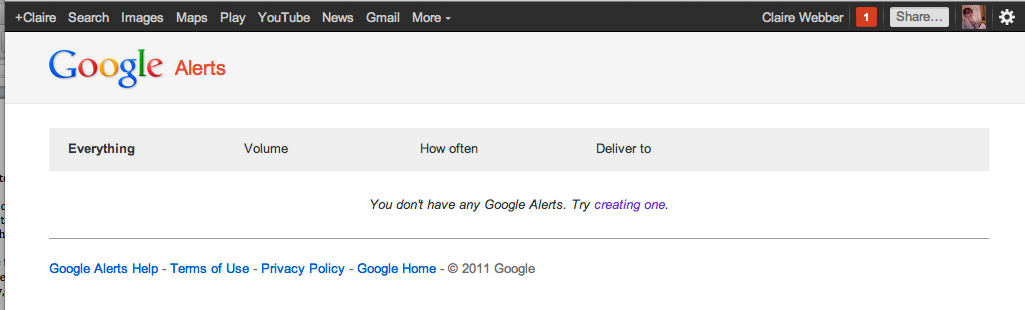
If you really distill the many difficulties of blogging, there are two issues that are the most arduous to contend with on the regular: monitoring who’s talking about you, and coming up with fresh and fantastic ideas. Luckily, Google already has you covered. Google Alerts is a free online tool that can alert you anytime it finds a new page on the ‘net that’s related… [Read More]
Filed Under: author platform, Authors, blogging, Blogs, Google, google alert, google alert how to, google alert tutorial, how to use google alert, internet
1 Comment


Anne Tyler’s novels are punctuation marks in my own lifeline. Her first novels I discovered in college — If Morning Ever Comes and The Tin Can Tree — but by the time I got to graduate school, Celestial Navigation, Searching for Caleb, and Earthly Possessions captured my fancy as a reader. As each of her novels came out, I found myself compelled to purchase the… [Read More]
If you have a book manuscript and you think you are ready to pursue publication, there is a timeline you should consider before letting your horse out of the gate before the race even begins. I’ve seen too many great book concepts go nowhere, because when they send a query letter out, they don’t have a proposal ready to go. Yes, a book proposal. When… [Read More]

Facebook, for better or worse, has become quite the meeting hall of 2012. It’s where we commune electronically to discuss the days’ news, to check out our friends’ latest photos, and, as an author, promote our blogs and books. Self-promotion has always been a bit of a tight-rope walk – you have work you believe in that you want to show the world!… but you… [Read More]

When you are building your author website from the ground up and trying to keep expenses low, it helps to have a friend who knows a thing or two about website design and development. You know, that friend you have that helps you out in a pinch and who can show you the ropes? Who asks only for your friendship – and maybe a free… [Read More]