
The business of publishing continues to evolve and new finance models have emerged offering authors more than the option to self-publish or go the traditional route. Between the five big commercial trade presses – Penguin Random House, Hatchette Book Group, Harper Collins, Macmillan, and Simon & Schuster – and self-publishing with Blurb, or Smashwords, there are new routes for writers to consider in their pursuit of publication. Small and independent presses can’t offer authors large advances or extravagant marketing campaigns, but they do offer many advantages over self-publishing including distribution. Most self-published authors recognize the difficulty of getting their books into retail stores and libraries because they lack access to the distribution systems used by publishers. Finding a good fit with a small publisher who champions your manuscript can be an ideal scenario for authors. Some presses, if they endorse your manuscript editorially, may negotiate with an author for a subsidy to proceed with publication. When an author invests in the initial production costs, it is possible to negotiate a higher copyright royalty rate in lieu of an advance. Subsidy publication is an avenue to explore. Find a benefactor, or if the author has the financial resources, to provide a subsidy for the production expenses of publication. Subsidy publication is a “dirty little secret” in the publishing business. Many traditional publishers don’t want it well known that such business arrangements can be made outside of their traditional editorial decisions. That’s because an author must still meet all their other editorial criteria…



eReading devices are one of the most polarizing topics among bibliophiles – but whether you’re glued to your Kindle or loyal to print-and-paper, being able to easily read ebooks on your computer is a revolutionizing experience. Why on a desktop? If you’ve got an eReader, you might not see the point in having a eReader program on your home computer. But consider: Being able to… [Read More]
Filed Under: ebooks, ereader, technology
1 Comment


If you are working towards publication and own an eReader, chances are there’s a copy of APE: Author Publisher Entrepreneur sitting on your Nook. It’s a manifesto on the art of self-promotion and marketing books aimed at the self-published author, but it’s making waves for wordsmiths of all publication inclination. Its author, Guy Kawasaki, wrote most of this bestselling eBook from a 5-by-5 closet of… [Read More]
Filed Under: author brand, book review, Marketing, marketing strategy, self-promotion, Social Media networks

Last week here, I spelled out the reasons why a comparative title analysis is so important to a book proposal. Today, the “how to” complete your research on the competition in the marketplace of ideas will be presented. This step-by-step process involves research, reading, and a critical market assessment. 1. Identify the genre, even the sub-genre, of books you will be searching for in your… [Read More]
Filed Under: Amazon, audience, key terms, product description, Readers, Sales rankings, Subject headings
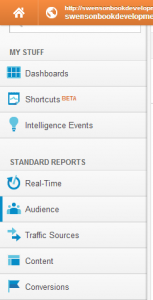
On 01/16/2013, Google updated their Analytics Interface. The updates changed some navigation interfaces, added new functionality, and made certain areas easier to access. The Swenson Book Development Google Analytics for Author blogs written before this update have been updated to reflect these changes. If anything has been noticeably altered in the blogs, it will be clearly marked to reflect the update. Luckily, many of the… [Read More]

“There’s never been a book like this,” is a phrase that may doom your book propsoal to oblivion. When writing a book proposal, an essential document to prepare is a comparative title analysis. This is a report which identifies the current bestselling books like yours. If there is nothing comparable to your book in the marketplace of ideas, then there may be a reason for… [Read More]