
In the pre-dawn hours of February 18, 1942, three American warships zigzagged in convoy along the south coast of Newfoundland. Caught in a raging blizzard, the three ships ran aground on one of the most inhospitable stretches of coastline in the world—less than three miles apart, within eight minutes of each other. The Wilkes freed herself. The Truxton and Pollux could not. Fighting frigid temperatures, wild surf, and a heavy oil slick, a few sailors, through ingenuity and sheer grit, managed to gain shore—only to be stranded under cliffs some 200 feet high. From there, local miners mounted an arduous rescue mission. In Hard Aground, based on eyewitness accounts of survivors and rescuers, and corroborated by archival and historical research, Bett Fitzpatrick tells the story of the men who saved themselves, the miners who carried survivors up the cliffs on their backs, and to the people of St. Lawrence who opened their homes and their hearts to the victims. Among them are seaman Edward Bergeron, who scaled the cliff and brought help, Lanier Phillips, the only black man to survive, Ena, who collected food and blankets and snapped the only pictures of that horrific day, and Clara, who took the last survivor home and nursed him through the night. Bett (Dorion) Fitzpatrick, grew up in Newfoundland when there wasn’t a child who didn’t know the story and the people who carried up the cliffs the 186 U.S. service men who survived the shipwrecks of the USS Truxton and USS Pollux. Award-winning author of Melanie Bluelake’s Dream (1995), Bay Girl (1998), and Whose Side Are You…


Fresh from the press, my new copy of Risk Rules: How Local Politics Threaten the Local Economy arrived and it is really a study of unintended consequences. Authors Marvin Zonis, Dan Lefkovitz, Sam Wilkin and Joseph Yackley offer a new way to understand the global political economy. Here are seven questions posed about the current state of affairs and the author’s answers. 1) Obviously, there’s… [Read More]
Filed Under: Agate Publishing, book launch, Business, Dan Lefkovitz, emerging markets, financial turmoil, Globalization, Joseph Yackley, leadership, Marvin Zonis, Middle East turmoil, Other People's Money, Sam Wilkin
No Comments

The past never goes anywhere. It is with us always. In the culture of the “now” we risk losing out on the transformative power of recollecting that which has passed away. Reflecting upon personal gains and losses through the lenses of accumulated experience and knowledge guides one towards a more meaningful life. Ignoring the past is folly. Know where you’ve been to get where you’re… [Read More]
If you want to watch a rising star with a bestselling book, look to Andrew Kessler and Martian Summer. He’s part gonzo journalist, i.e. Mary Roach with gonads, and part wacky hip ad-man, i. e. his real life gig as Creative Director, HUGE. The social media buzz isn’t shameless self-promotion; it’s comedy central. Yup, the book trailers are only a piece to this sweet marketing mix… [Read More]
Filed Under: Andrew Kessler, book trailer, heroes, humans, Mars, Martian Summer, Mary Roach, NASA scientists, Regolith, sol, space, time shifting
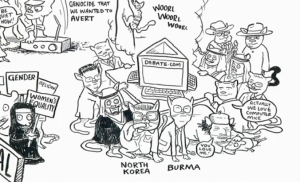
Art Spiegelman wrote the only comic book ever to have won a Pulitzer Prize. Maus: A Survivor’s Tale is a memoir of his father, Vladek, a Polish Jew and Holocaust survivor. In Spiegelman’s comic book, Jews are depicted as mice, while Nazis are depicted as cats. In an obvious nod to Spiegelman’s artistic genius, this animation video by Evgeny Morozov uses mice to represent citizens… [Read More]
Filed Under: Art Speigelman, Cyber Activism, Cyber Terrorism, Digital, digital captives, Digital Immigrants, Digital Native, digital renegades, Evgeny Morozv, global politics, internet, Internet in Society, Jill Swenson, RSA, RSA animate, Social Energizer, Social Media, Social Media networks, technology, technology influences civil engagement

In light of the recent Mid-East upheavals, I came across this video that I consider a new perspective, and wanted to share it with you. The assumption has been that The Internet helps promote democracy. That’s what the Buzz Leaders tell us. You’ve probably heard the stories of bloggers and Twitter users helping to protest against evil dictators or unfair governments. In an effort to… [Read More]
Filed Under: cartoon, Cyber Activism, Cyber Terrorism, cyber-utopianism, Digital, digital captives, Digital Immigrants, Digital Native, digital renegades, Evgeny Morozv, global politics, internet, Internet in Society, new perspective Mid-East turmoil, RSA, RSA animate, Social Energizer, Social Media, Social Media networks, technology, technology influences civil engagement, video