
I’m pleased to announce Cathryn J. Prince, author of For the Love of Labor: The Life of Pauline Newman, secured an offer on her exclusive submission to Alison Syring, again, at University of Illinois Press for a book about the life and death of Barbara Robbins, the CIA’s first female officer killed in the line of duty and first American female killed in Vietnam during the 1965 Embassy bombing in Saigon, and how it pulled America deeper into the conflict in Southeast Asia. A Bombing in Saigon will be released in 2029.
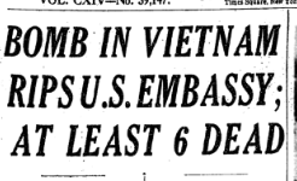
This is the story of a 21-year-old who joined the CIA fresh out of college, feeling duty-bound to serve her country and imbued with a sense of invincibility and optimism. And it is also about how Robbins’ story reflects the mood of the nation—still optimistic and confident as the politicians kept striding forward into the Vietnam War, in spite of the growing disillusionment nipping at its heels.
Barbara Robbins was born in 1943 in South Dakota while her father was off fighting in the Pacific. Although she was badly injured in a car accident when she was three, her parents resisted the temptation to hover. Instead they nurtured her curiosity and watched her grow into an energetic and bold young woman. After graduating high school, Robbins matriculated at Colorado State University to study French. Then, when the CIA came calling—at a time when most Americans would be hard pressed to find Vietnam on a map—Robbins, an ordinary citizen from an ordinary midwestern town, answered.
It wasn’t until 2011 that the CIA acknowledged Robbins as one of their own during a private ceremony in which her name was inscribed next to her star on the Memorial Wall inside the agency’s main lobby. She is the youngest CIA employee ever killed in the line of duty.
Cathryn Prince teaches journalism at Fordham University in New York. She brings a journalist’s sensibility to her writing through meticulous research and investigation methods. Prince’s passion lies in revealing and personalizing little known and forgotten episodes of history, while placing them in a larger political and cultural context.